
Cut Signature vs On-Card Auto: What That Window on the Card Actually Is
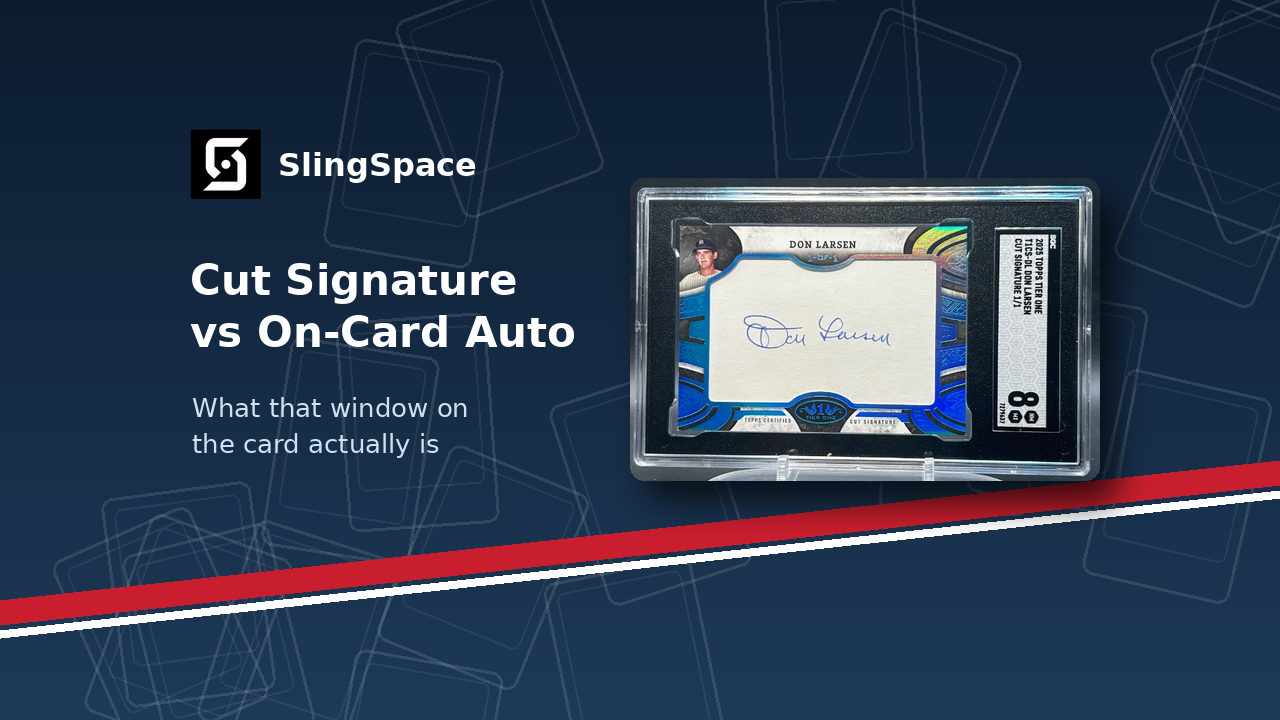
Some autograph cards show the signature in a small window, on what looks like an old piece of paper. That is usually a cut signature, and it is a different thing from an on-card or sticker auto. Here is how the three types differ and how to tell which one you are holding.
Three ways a signature gets on a card
Card makers use three methods to put an autograph on a card:
- On-card auto: the player signs the card itself.
- Sticker auto: the player signs a sticker, and the maker sticks it on the card.
- Cut signature: the maker cuts a signature from an older signed document and builds it into a new card.
Only the first one means the signer handled that exact card.
On-card autos
An on-card auto, also called hard-signed, has the ink directly on the card stock. There is no label in between.
Topps says the market has shown that on-card autographs carry higher demand. CGC's glossary makes the same comparison and calls sticker autos less desirable than on-card ones.
Sticker autos
With a sticker auto, the maker sends a stack of stickers to the player. The player signs them and sends them back, and the maker applies them to finished cards.
It is still a real autograph. Makers use stickers when speed to market or the player's availability makes on-card signing hard. The trade-off is that the signature sits on a label, not on the card.
Cut signatures
A cut signature starts life on something else. The maker gets a signed document, such as a contract or a check, cuts out the signature, and mounts it into or onto a new card.
Here are two glossary-style definitions side by side:
- Topps Ripped: the producer acquires a document with a signature, cuts the signature out, and incorporates that piece into a brand-new card.
- CGC: an autograph fragment, or an autograph cut from a larger document, that is embedded or mounted into or onto a card. CGC also lists "cut auto" as another name.
Cut signatures are generally used for people who have died and can no longer sign. That is why the names on cut checklists tend to be legends.
Why the window matters
The window on a cut signature card is a frame for a piece of paper that was signed years before the card existed. The player never touched the card.
That changes what the autograph tells you. The signature is real, but the card is not a signed card in the way an on-card auto is. It is a new card built around an old signature.
A window alone does not prove a cut, though. 2026 Topps Five Star Baseball, for example, has Five Star Fabric cards with a jumbo swatch set in a star-shaped die-cut window. Check what is in the window, not just the shape.
A current example: 2026 Topps Five Star Baseball
2026 Topps Five Star Baseball hit the market on October 28, 2026. Topps' box guide says the product is built on on-card signatures, and it also includes a Five Star Cut Signatures set.
Topps describes those cut signatures as 1/1s from some of the greatest MLB players of all time. Collectors see an on-card auto and a cut signature in the same product, which is exactly where the difference matters.
How to tell which one you are holding
Before you buy or price an autograph card, work through these checks:
- Find the card on the checklist. A Cut Signatures set is listed by that name.
- Look at where the ink sits. Ink on the card surface is on-card. Ink on a sticker or label is a sticker auto. Ink on a separate piece of paper set into the card is a cut.
- Read how the card is described. On-card and sticker autos are signed new for the card maker. A cut comes from an older document.
- For a graded card, look up the cert number in the grader's online database to confirm the card and its details.
If a listing says "auto" and nothing else, ask the seller which type it is. Clear photos of the signature area usually answer it.
What this post is not
This post explains the three autograph types. It is not a price guide, and it does not rank one player's cut signature against another's.
Subscribe to the Blog
Get notified when new articles are published. No spam — just new posts.