
Topps NOW Print Runs: What the Sales Window Tells You, and What It Doesn't
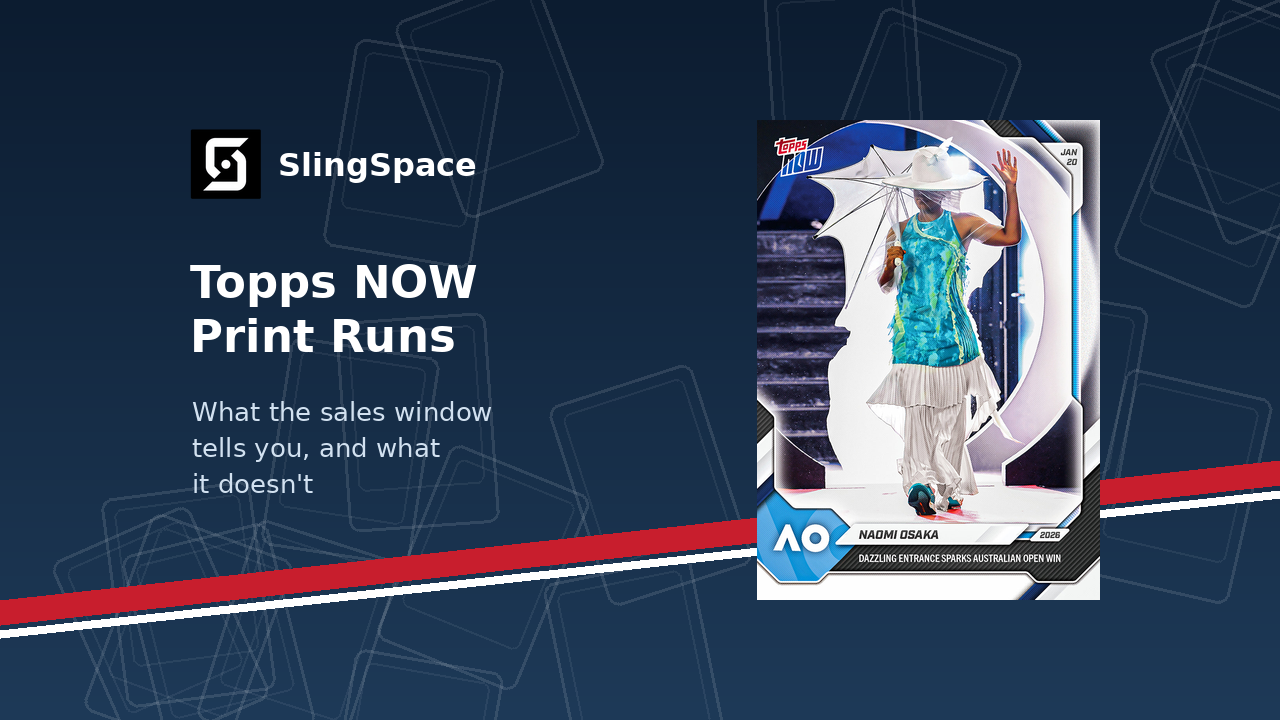
A Topps NOW sales window tells you when you can order. The final print run tells you something different: production quantity, not future value.
A closing clock is not a print-run announcement
Topps NOW is a print-on-demand card program. Topps offers each release for a limited sales window and locks the print run after that window closes. Its program page directs collectors to the Topps NOW Archive for published print runs.
That means the order deadline and the production total answer different questions. The deadline tells you when the direct sale ends. It does not tell you the final quantity before Topps publishes it.
Topps' product terms say print runs are revealed after the sales window expires. They do not promise an immediate announcement when the clock reaches zero. If the figure is missing, leave it unknown rather than filling the gap with a guess.
An open-edition base card is also different from a serial-numbered parallel. Topps' product pages list open-edition base cards separately from numbered foil parallels. Do not read a published base print run as proof that each base card carries an individual serial number.
Before comparing listings, check what the number describes:
- The published print run for the identified card or set.
- The serial-numbered edition of a particular parallel.
- The card number that identifies the release, rather than its production quantity.
Those labels are not interchangeable. Save the exact product page with your collection notes so a number keeps its context.
A parallel is not the whole release
A serial number belongs to a particular edition. Its denominator describes that numbered version, not the entire Topps NOW release. A base card and a numbered foil parallel should not share the same inventory description.
The distinction matters when you read a listing that calls a card limited.
Ask what is limited:
- The order window.
- The published base quantity.
- The specific parallel edition.
A short sales window alone does not answer the other questions.
Read the individual product's hit terms as carefully as its print-run label. Topps' program page says non-base hits may replace a base card. Its individual-card product pages also describe replacement hits rather than an automatic extra card.
Sets can have different terms.
The MLB All-Star Game set page describes a guaranteed special-card slot that can contain:
- A numbered parallel.
- An unnumbered parallel.
- An autograph redemption.
That is not the same promise as an individual base-card order with a chance of replacement.
Use the product's wording, not a rule borrowed from another release. A redemption is a redemption; do not record it as an autograph already in hand.
Topps says replacement-hit odds are based on total cards ordered, not the number of separate orders. Splitting a purchase into separate checkouts is not an advertised odds advantage. A published base print run alone is not enough to calculate every possible hit outcome.
Production quantity is not a delivery date or a price forecast
The sales window also affects the order timeline. The product pages reviewed here say processing begins after the sale clock expires. They distinguish that processing period from the time a package spends in transit.
Those pages say an upgraded shipping method expedites shipping, not processing. Read the product's stated estimate before counting forward from checkout. An order confirmation does not mean the card has finished production or entered the carrier network.
Keep these details separate in your order notes:
- The sales window and its closing status.
- The product's processing or dispatch estimate.
- The shipping service selected.
- The shipment status once tracking is available.
Do not turn an estimate into a promised arrival date. The print-run announcement is not a shipment confirmation either. Neither fact substitutes for an update on your own order.
A production total is useful for describing supply. It does not identify the number of distinct collectors who bought, since quantity sold and buyer count are different measures. It also does not tell you how many copies owners will offer for sale.
Most importantly, no print-run figure guarantees a resale price. A smaller quantity is not a promise of stronger demand. Record the published figure as a production fact, not an investment conclusion.
For collection records, keep these in separate fields:
- The base print run.
- Parallel identity.
- Fulfillment status.
You will know:
- What was produced.
- What version you own.
- What still needs confirmation.
Subscribe to the Blog
Get notified when new articles are published. No spam — just new posts.